Dignity and legitimacy
Power is justified only when it serves humanity and recognizes the irreducible value of every person.
Philosophical treatise · Digital edition
In the Age of Artificial Intelligence
A reflection on the dignity, freedom, and responsibility of a humanity that can still decide what to do with the power it has created.
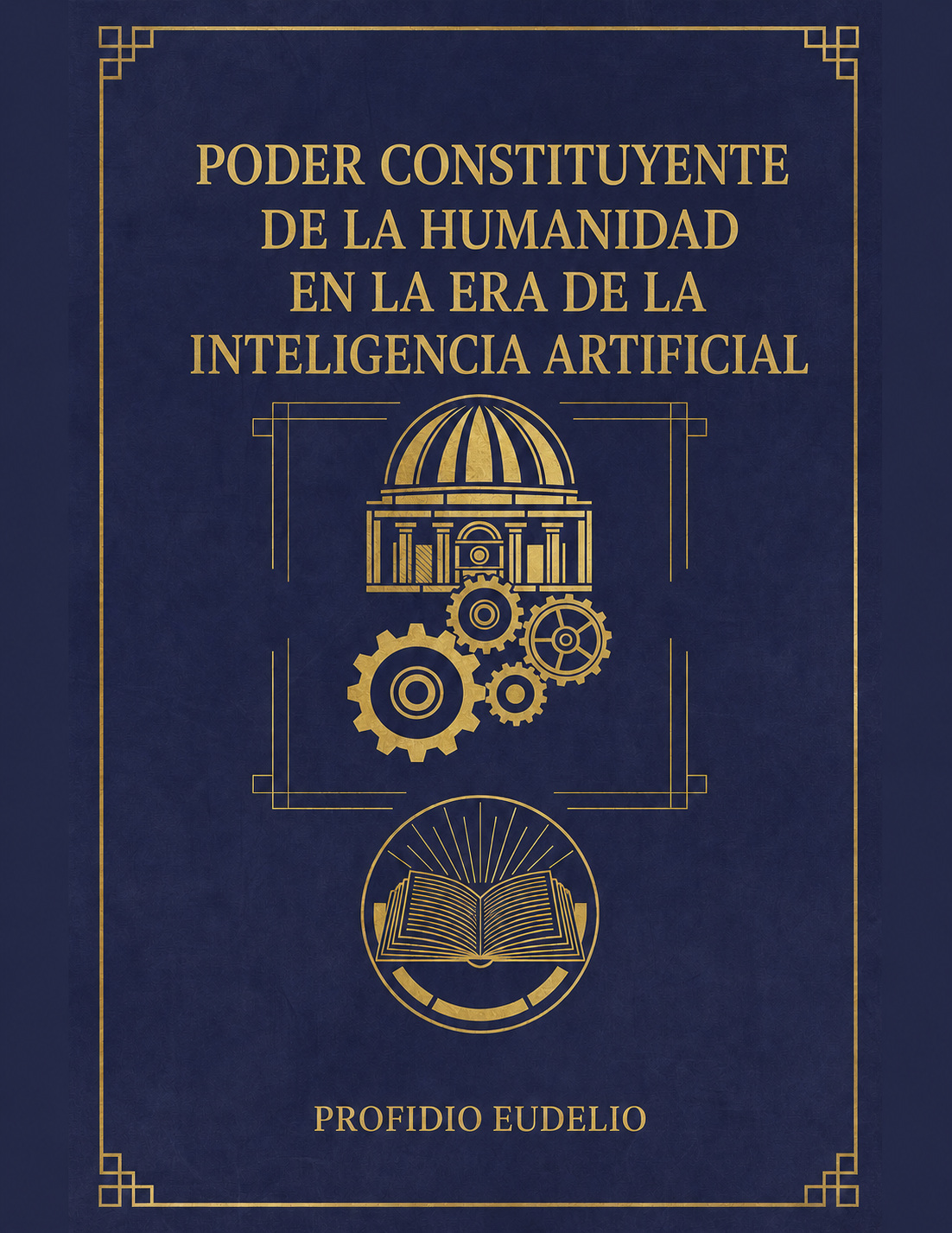
First edition · 45 chapters · Available to buy on Amazon
No economic interest, artificial intelligence, form of power, or technological development may become an end superior to the human person.
Ideas to open the debate
“The question is no longer merely how far humanity can advance, but what kind of humanity is advancing.”
PROFIDIO EUDELIO · Introduction
“Understand before transforming, discern before deciding, and legitimize before exercising power.”
PROFIDIO EUDELIO · True Progress
“The more profound and irreversible a decision, the greater the justification it must require.”
PROFIDIO EUDELIO · Introduction
I
Humanity has created systems capable of expanding knowledge, automating work, guiding decisions, and profoundly transforming social organization. Yet the growth of that power does not prove that our ethical, legal, and political capacity to govern it has increased in equal measure.
In the face of technological power capable of transforming the human condition, a decisive question emerges: can humanity assume the power to determine its own destiny?
II
Letter to the Humanity of the Twenty-First Century
Humanity is undergoing a transformation capable of altering work, education, political organization, the economy, and even our understanding of consciousness. In the face of such power, human dignity cannot be reduced to a rhetorical declaration: it must constitute the limit and purpose of every technological decision.
This Letter calls for the preservation of freedom, autonomy, and collective responsibility. No artificial intelligence, economic interest, or form of power may be placed above the human person or foreclose the right of future generations to reconsider their own destiny.
Humanity must not abdicate its constituent condition.
III
The work connects problems often studied separately and submits them to a single question: what form of progress preserves the freedom to choose again?
Power is justified only when it serves humanity and recognizes the irreducible value of every person.
The efficiency of an intelligence cannot replace human judgment, dissent, or decision-making.
Automation requires us to separate human dignity from the economic utility assigned to each life.
Global technological power requires safeguards, accountability, and democratic oversight.
The possibility of nonbiological experience demands prudence, rigor, and new moral questions.
No generation should foreclose the capacity of those that follow to reconsider their destiny.
IV
From the introduction
Humanity now stands before the power it has created. It has attained a capacity for transformation whose full magnitude no previous generation could likely have imagined: it can intervene in matter, modify organisms and ecosystems, communicate instantaneously on a planetary scale, automate complex processes, and develop artificial intelligence systems capable of performing functions that for centuries seemed exclusively human. Yet this expansion of power does not, by itself, demonstrate an equivalent evolution in the maturity with which we exercise it.
Humanity has developed extraordinary instruments to transform the world, but it has not necessarily cultivated, in equal measure, the ethical, political, and civilizational capacity to govern the consequences of that transformation. The question is no longer merely how far humanity can advance, but what kind of humanity is advancing.
V
The first English edition is now available to buy on Amazon Kindle as of October 15, 2026.
International edition
A translation reviewed for terminological and conceptual fidelity to preserve the work’s philosophical meaning.
Original edition
The complete revised version, comprising 45 chapters and the Letter to the Humanity of the Twenty-First Century.
Foundational text
An ethical and political proposition on dignity, freedom, and constituent power in the face of artificial intelligence.
Community of readers
This space welcomes questions, objections, and reflections from readers, educators, and researchers. Dialogue is part of a work that does not seek to close the debate, but to open it responsibly.
Institutional email
poderconstituyente
Editorial information, news, and dialogue with readers.